c-VEDA c-VEDAConsortium on Vulnerability to Externalizing Disorders and Addictions
Overview About People Partners Publications Resources Dataset Dataset Versions

Quick Find:

  • Project Summary
  • Aims & Objectives
  • Recruitment Centres

About the cVEDA study

Project Summary

The Consortium on Vulnerability to Externalizing Disorders and Addictions (c-VEDA) is jointly funded by the Indian Council for Medical Research (ICMR) and the Newton Grant from the Medical Research Council (MRC), United Kingdom. Principal Investigators for this study are Professor Gunter Schumann, King’s College London (KCL; London, UK) and Dr Vivek Benegal, National Institute of Mental Health and Neurosciences (NIMHANS; Bangalore, India). Project coordinators are Ms Yuning Zhang (London) and Ms Nilakshi Vaidya (India). The India-UK project is an international collaboration between Prof Gunter Schumann at King’s College London and Prof Vivek Benegal of the National Institute for Mental Health and Neurosciences (NIMHANS), Bangalore and our Indian partners from Bangalore, Mysore, Calcutta, Chandigarh and Manupur. Our aim is to investigate if environmental and genetic risk factors in industrialised countries and emerging societies shape brain function and behaviour in distinct ways, thus leading to different risk constellations and neurobehavioural trajectories for substance misuse and externalising disorders.

To address this aim we will establish a comprehensive database allowing comparative analyses of behavioural trajectories in childhood and adolescence, which provide a platform for sustained India-UK collaborations in mental health research. This platform will ascertain a great variety of environmental factors (exposome), biological samples as well as detailed neuroimaging analyses. We propose to compare insights into etiology and trajectories into substance abuse and externalising disorders gained from major European and UK studies including the longitudinal imaging genetics study “Reinforcement-related behaviour in normal development and psychopathology” (IMAGEN) and the “Avon Longitudinal Study of Parents and Children” (ALSPAC) with existing Indian cohorts. The Indian cohorts, which comprise >14.000 participants aged 0-25 years include both high risk for substance misuse and population-based individuals from different social and environmental (rural and urban) backgrounds. They have been selected to cover the developmental period assessed in the UK cohorts, thus rendering the studies comparable. We aim to enrich the Indian cohorts, which have mainly been designed to investigate somatic disorders by adding a comprehensive assessment of mental health, externalising behaviour and substance use disorders involving psychometric and neuropsychological characterisation, as well as biological sampling in >10.000 participants with an age range of 6-23 years. Assessment instruments and protocols have been selected to allow comparison to IMAGEN and ALSPAC. We will randomly select among the cohort participants 1000 individuals aged between 10 and 23 years for neuroimaging, genetic and epigenetic analyses. We will control for socio-cultural and environmental influences by investigating determinants of substance abuse in SCAMP, a UK cohort recruiting 6.500 11-13 year old adolescents, >1000 of which are of South Asian descent. Together these data will allow for the most comprehensive comparative analysis of brain development and behaviour across different social and cultural environments to date.

c-VEDA is funded by an MRC-ICMR Newton Grant to Gunter Schumann and Vivek Benegal.

Aims & Objectives

Project Aims

The aim of the project is to accumulate a developmental cohort of children, adolescents and young adults, gathered from 1] existing birth cohorts and 2] children at risk for addiction, in India, so that we may enrich the existing data on birth, parental and perinatal information, growth parameters with longitudinal data on brain development , temperament and behaviour, as well as information regarding gene x environment influences, in order to create a data repository and biobank, which will enable prospective follow-up of these subjects through the developmental life-span and the study of gene x environment mediated development of states which increase risk or resilience to addictive disorders and associated psychiatric disorders.

To achieve this aim, this project incorporates and integrates FOUR sub-projects, which involve the development of:

  • A high Risk Cohort of children, adolescents and young adults deemed at-risk for addictive disorders due to high family loading for addictive disorders to be recruited from offspring of persons seeking treatment for substance use disorders;
  • An Exposures Cohort of children, adolescents and young adults in the general population who are exposed to different environmental risk factors during the developmental period;
  • A Repository to accumulate data pertaining to the above enquiries and a bio-resource to facilitate immediate and long-term research studies;
  • An Exposures Cohort of children, adolescents and young adults in the general population who are exposed to different environmental risk factors during the developmental period – specially situated in the North-eastern part of India with specific funding set aside for Building Human Resource Capacity with Training.

Objectives

  • Establish an accelerated and planned missing longitudinal cohort in India of over 10,000 individuals within specific age ranges 6-11, 12-17, 18-23 years, by enriching existing birth cohorts and high risk cohorts (offspring of treatment seeking alcohol and other substance dependent patients).
  • Assess addictive behaviour, in adolescents and young adult members of the cohort and in parents of all subjects, both substance-based and behavioural, and carrying out a detailed behavioural characterization, with special emphasis on externalising behaviour (temperament and disorders), as well as a clinical assessment according to DSMV/ICD10.
  • Assess environmental exposures in utero and through the developmental span to select risk and resilience factors, including psychosocial stressors, socioeconomic status, societal discrimination, food and asset security, physical activity, nutrition and environmental toxins, which are thought to impact gene expression, brain development and eventually temperaments and behaviours.
  • Assess neural processes associated with externalising behaviours and addictions using functional and structural neuroimaging in a randomly selected deep phenotyping subgroup of 1000 individuals.
  • Investigate gene x environment-mediated modulation of brain development, and externalising and addictive behaviour through genetic and epigenetic studies in the deep phenotyping subset.
  • Establish a sustained and accessible data platform including a bio-resource with integrated database and bio-bank to facilitate analyses by consortium partners as well as collaborators investigating other areas of mental health, and its interface with physical health.
  • Build capacity by joint UK – Indian analysis teams, technology transfer, training sessions and summer schools, dedicated neuroimaging and bio-statistical support teams as well as the provision of short-term fellowships.
  • Provide pilot data for the establishment of a nationwide mental health cohort in India.
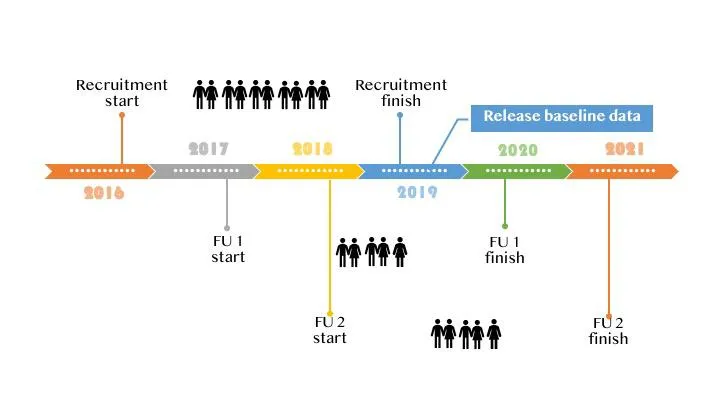
cVEDA-timeline (1)

Recruitment Centres

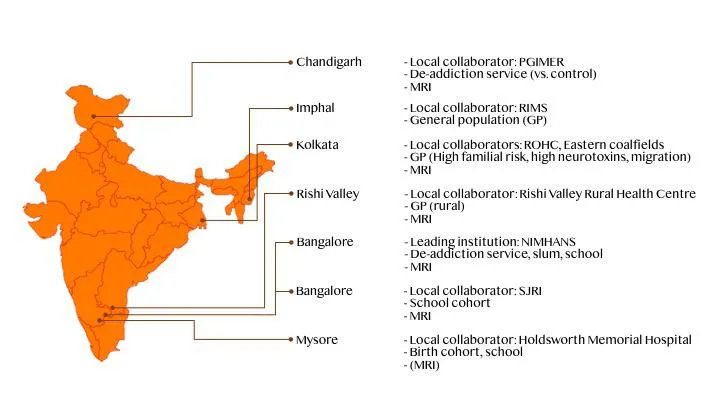
The multiple recruitment and acquisition centres of c-VEDA cover 6 geographical regions across both urban and rural India representing the socio-cultural diversity of India.

cVEDA-site-map

National Institute of Mental Health and Neurosciences, Bangalore

The National Institute of Mental Health and Neurosciences is the leading Indian collaborator on the cVEDA study. The Centre for Addiction Medicine at NIMHANS, Bangalore, headed by Dr Vivek Benegal (Principal Investigator for cVEDA), is the Regional Centre for the southern region, under the National Drug Deaddiction Programme of the Ministry of Health and Family Welfare, Government of India. This centre runs outpatient and inpatient services, and caters to around 100 patients per week. The center has a strong focus on research since its inception. The research directions have been shaped, both by its location as well as the research interests of the individual faculty. A major direction has been the study of the prevalence and patterns of alcohol, tobacco and other drug use in India. This has included initiating some of the first enquiries in the country, on patterns of use, economic consequences and social cost of alcohol, normative use of alcohol among women and substance use in special risk groups which have contributed to the growing acceptance of substance use especially alcohol as a critical public health problem in India. The other significant direction has been the study of genetic and neurobiological factors which underlie the susceptibility to addiction, especially in young people.

The research group for cVEDA at NIMHANS, led by Dr Benegal, has accumulated data on various endophenotypes of vulnerability to addictive disorders and other mental illnesses, including measures of brain volume, white matter integrity, cognitive functions and genetic variants associated with addiction and mental illnesses. Subjects will be drawn from among the children of this large patient cohort at this site.

St. John’s Research Institute, Bangalore

St. John’s Research Institute (SJRI) is an integral part of the St. John’s Academy of Health Sciences that is administered by the Catholic Bishops Conference of India (CBCI) and was conceptualized in the year 1998 and moved into the present facility in the year 2004. The Academy has a broad, holistic vision and an approach to health problems of the country. Since its inception, the Academy has been involved in training of health professionals and service delivery through the St. John’s Medical College and Hospital, which is today ranked among the premier medical institutions in the country. The SJRI was set up with a commitment to pursue excellence in research and to build capacities in health-related research.

Regional Institute of Medical Sciences, Imphal

The Regional Institute of Medical Sciences (RIMS) was established in 1972 is situated in a picturesque locality at Lamphelpat in Manipur, India. The objective of this premier institute is to impart quality medical education and ameliorate the health condition of the eight states of North Eastern Region including Sikkim. It is run by a society named “North Eastern Regional Medical College Society” which was duly registered under the Manipur Societies Registration Act, 1989.

The Psychiatry Department headed by Dr R.K. Lenin Singh also runs its own Drug Treatment Clinic (DTC) under the scheme “Enhancing the functioning of Drug De-Addiction Centres (DACs)”, under the sponsorship of Drug De-Addiction Program, Ministry of Health and Family Welfare (DDAP, MOH&FW). RIMS has also undertaken training program for GDMOs for North Eastern states under NFCDA (Ministry of Finance) and identified as Regional Technical Training Centre for Northeast, under the project HIFAZAT (funded by GFATM round 9 grant) for training of staff working under the National AIDS Control Program.

National Institute of Occupational Health ICMR, Kolkata

ICMR-Regional Occupational Health Centre (ROHC), Eastern is the eastern regional division of National Institute of Occupational Health (NIOH) and is a nodal centre of Indian Council of Medical Research (ICMR), Department of Health Research, Ministry of Health & Family Welfare, Govt. of India to investigate occupational and environmental health problems. This centre has initiated and participated in a number of research projects on health effects of different environmental toxins, e.g., arsenic, fluoride, lead, tobacco, aromatic hydrocarbons etc. at the population level. At present, scientists from this organization are investigating health effects of arsenic exposure, biomass fuel exposure, health hazards among waste disposal workers as well as chronic environmental pesticide exposure. Currently a case control study to find association of chronic environmental pesticide exposure with neurodegenerative disease, viz., dementia, Parkinson’s disease and depression using a paradigm of biomarkers and epidemiological information has been initiated in a rural, predominantly agrarian district in West Bengal. ROHC, Eastern was also involved in a multi-agency investigation involving National Centre for Disease Control (NCDC), India and Centers for Disease Control and Prevention (CDC), USA to investigate possible involvement of pesticides and other toxins in etiology of Acute Neurological Syndrome (ANS) among rural children in Muzaffarpur, Bihar and Malda, West Bengal. This institute is also developing projects on health effects of air pollution in eastern India and chromium and volatile organic compound exposure among tannery workers.

Postgraduate Institute of Medical Education and Research, Chandigarh

The Postgraduate Institute of Medical Education and Research Chandigarh was conceived in 1960 as a centre of excellence which would endeavour to develop patterns of teaching in postgraduate medical education in as many branches as possible and attempt to produce specialists in several disciplines of medicine. It was also envisaged that these specialists would spread out in the country in various medical colleges and medical institutions and impart medical education of highest standard to the students and set up nucleus of excellence in their own institutions. The PGIMER was also given the responsibility to broaden the horizons of medical knowledge by intensive research in the field of health.

Holdsworth Memorial Hospital, Mysore

Mission Hospital is a self-supporting, self-reliant institution and is totally managed indigenously. The hospital runs on a no-profit-no-loss basis, as the Hospital aim is to provide high quality service to a largely poorer section of the community. Aims and Objective

In collaboration with Medical Research Council of Britain, a pioneering work on fetal origins of adult disease (ex. Diabetes mellitus, hyerptension, heart disease, etc. is being carried out).

A cohort of close to 600 children are being followed up to study in relationship between Low Birth Weight and Incidence of Cardio-Vascular Disease in Adulthood and a project on Glucose Tolerance during pregnancy in South India: its relationship to the Mother’s Body Composition and its effect on Foetal Growth.

HMH is recognized by the Ministry of Science and Technology, Government of India, for research work.

Rishi Valley Rural Health Centre

The Rishi Valley Education Centre has, for several decades, been providing basic health services to the nearest villages. Perceiving a need for a healthcare programme that would provide affordable, quality primary level health care for the rural poor, a programme was started in July 1999 when a doctor (an old student) joined the school with such an intent in mind.

This outreach activity finally took concrete shape in January 2001, with the training of an optometrist and setting up of an eye care programme. Over the years the Rural Health Centre (RHC) has added other programmes and facilities besides collaborating in research in the field of Public Health.

The RHC provides primary level health care to about 200,000 BPL (Below Poverty Line) people. 95% of the patients who access the RHC have income levels below Rs 48,000 pa

These families are resident in villages and hamlets of the Northern parts of Chittoor District, as well as from adjoining parts of Anantpur, Kadapa (YSR) district and Karnataka.


Key publications

Study Protocol

Consortium on Vulnerability to Externalizing Disorders and Addictions (cVEDA): A developmental cohort study protocol

BMC psychiatry. 2020 Dec;20(1):1-4.

Cohort Profile

The Consortium on Vulnerability to Externalizing Disorders and Addictions (c-VEDA): an accelerated longitudinal cohort of children and adolescents in India

Molecular psychiatry. 2020 Aug;25(8):1618-30.

© Copyright 2026 | cVEDA | All rights reserved

Last updated 18 May 2026.